

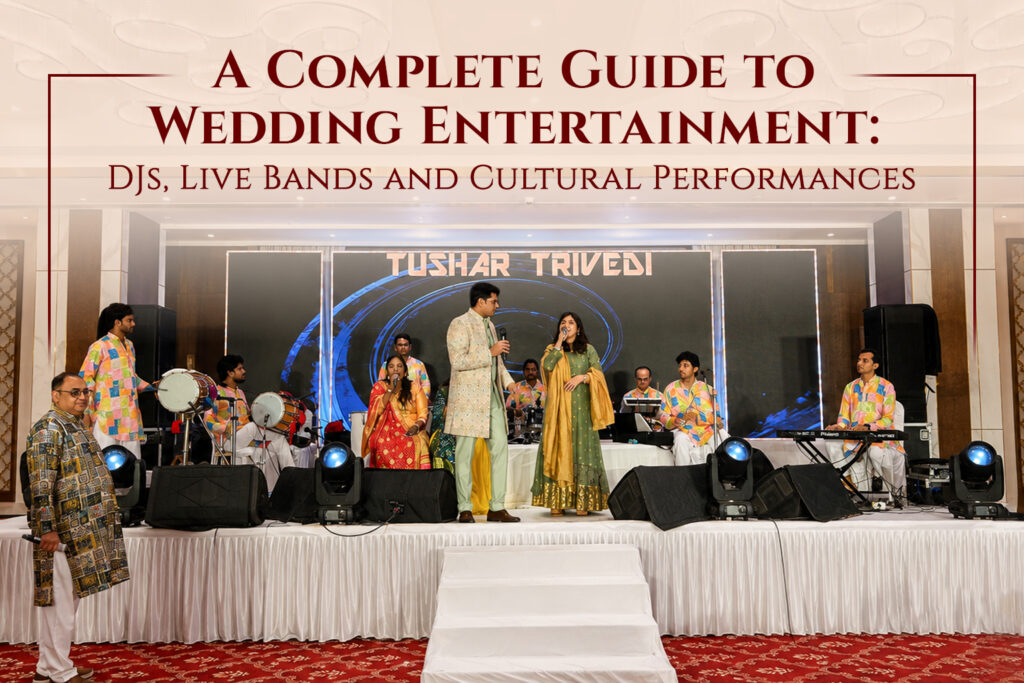
There is a moment at every wedding when you discover whether your wedding entertainment plan worked. Dinner has been served, a few older guests are collecting their shoes and the music either holds the room or it does not. Some weddings empty by 10. Others run until the lights come up with the whole family still on the floor. The difference is rarely the budget. It comes down to who is playing, what they are playing and when.
Understanding What Wedding Entertainment Is Meant to Do
Entertainment has three jobs at a wedding and only one of them involves dancing.
The first is filling gaps. Weddings run on a loose schedule and there is always a stretch where guests are seated with nothing happening. The second is marking moments, giving the entry, the garland exchange and the first dance a sound of their own. The third is giving guests something to do together, which is what people actually remember about a celebration years later.
Plan for all three and the evening holds its shape by itself.
Working with a Wedding DJ
A good DJ is a crowd reader first and a music collection second. The skill lies in noticing that the floor is thinning and changing direction before it empties.
When you meet one, ask which weddings they have played and how large the halls were, because the size of a room changes how sound travels and how a crowd moves. Give them a short must-play list and a firm do-not-play list. Most families discover they have strong feelings about the second one.
Ask whether they will also handle announcements. A DJ who can hold a microphone confidently saves you from appointing a nervous cousin as the master of ceremonies. And put your key timings in writing, since overtime charges after midnight have surprised many families.
Live Bands and Acoustic Sets for the Quieter Hours
Live music suits the parts of the evening where people are talking. An acoustic duo playing softly while guests move through the greeting line lifts the whole room without competing with conversation.
Different acts suit different moments. Brass bands belong to the baraat. Shehnai and sitar work beautifully around the muhurat. A four-piece band during dinner keeps the atmosphere warm while guests eat.
Two practical points. Live acts need floor space, a proper soundcheck slot and power that has been confirmed in advance. They also take breaks roughly every forty-five minutes, so arrange a playlist to cover those gaps. Silence between sets is where an evening loses its momentum.
Cultural Performances That Bring Tradition into the Room
Cultural performances give a wedding its character and they involve guests in a way that a playlist cannot.
Dhol players at the entrance turn an arrival into an occasion and they need no technical setup at all. Garba and dandiya circles bring three generations onto the floor together, which is a rare sight at any function. Folk singers and traditional troupes from Kutch and Gujarat suit families who want their heritage present in the celebration rather than mentioned in passing. A short classical dance piece works well between speeches, giving the room a change of pace.
The practical note here is space. Circle dances need an open floor with seating pushed back, so decide this before the layout is finalised and not on the morning of the function.
Planning Entertainment for the Sangeet Celebration
The sangeet celebration is where entertainment becomes the entire point of the evening and where families most often lose control of the running order.
Fix the number of performances early and hold to it. Six well-rehearsed acts will hold a room and attention starts to drift somewhere around the forty-minute mark. Give every group a rehearsal slot at the venue if possible, since choreography that worked in a living room behaves differently on a stage.
Order matters. Open with the children, because guests are at their most generous early. Place the cousins in the middle where energy runs highest. Keep the parents or a surprise act for the end, then hand the floor straight over to the DJ while everyone is still standing. Appoint one person to announce and keep things moving and make sure it is not the bride.
Be sure to check out Guide to Hosting a Sangeet Ceremony in a Banquet Hall to know more about Sangeet celebration.
Matching Entertainment to Your Banquet Hall
Every plan depends on the space it happens in. High ceilings carry sound cleanly. Long, narrow banquet halls need speakers placed carefully so guests at the back hear the same mix as those at the front.
Confirm the power load and backup arrangements with the venue before booking a large rig. Check where the stage and the dance floor sit in relation to the dining area, since guests should be able to eat without shouting over the music. Ask about the venue’s own sound restrictions too. Across Mumbai, loudspeakers are not permitted between ten at night and six in the morning, so build your schedule around that limit rather than discovering it at eleven.
Scale gives you options. Our banquet hall in Ghatkopar holds up to 4,000 guests across three halls, which leaves room for a full stage, a live act and an open dance floor at the same time.
Our banquet hall in Airoli offers two halls for gatherings of 1,000 to 1,200 guests, suited to families who want their sangeet and performances in a setting that feels contained and personal.
Booking Timelines and Costs Worth Confirming
Popular DJs and established bands are booked six to nine months ahead for the November to February season, and the good ones go first.
Ask exactly what the quoted price includes. Lighting, effects, additional speakers, a second engineer and travel are often listed separately. Confirm the arrival time for setup, the finish time and the charge beyond it. Then share the final schedule with your venue team, your caterer and your photographer, so everyone is working from the same running order.
Entertainment planned properly does not feel planned at all. Guests simply find themselves staying longer than they intended, which is the highest compliment a wedding can receive.
Speak with the team at Bhanushali Banquet to plan your entertainment, staging and sound around the space before you confirm your artists.
One is enough for most weddings. Families usually book a live act for a single segment, such as the dinner hour or the baraat, and keep a DJ for the rest of the evening. Booking both for the full function adds cost without adding much for guests.
Around 5-10% is a reasonable working figure, covering the DJ, sound, lighting and any live or cultural act. Sound and lighting often account for more of that figure than the artist’s own fee.
Yes, and it is worth confirming at the time of booking. Dancers and live acts will need somewhere to change and a set of meals held back for them, since they usually eat after the guests. Adding them to your final headcount avoids a scramble on the day.